

We don’t usually get to work on buildings this beautiful.
The new headquarters of 475 High Performance Building Supply in Brooklyn recently received a 2026 AIA New York Design Award — and we were genuinely pleased to see it recognized. It’s an exceptional building. A foam-free, dual Passive House certified office, warehouse, and showroom designed by Ryan Enschede Studio, built with a level of material honesty and craftsmanship that’s rare in commercial construction.
We were brought in specifically to handle the solar. And we think it’s worth being clear — and generous — about who did what.
The Canopy Is Theirs. The Solar Is Ours.
The rooftop photovoltaic canopy is one of the most striking features of the building. That beautiful timber-framed structure — the wood, the joinery, the way it sits above the rooftop terrace against the Brooklyn skyline — was designed and built by 475 High Performance Building Supply. Their expertise in mass timber construction, building enclosures, and high-performance detailing is evident in every inch of it. They built something genuinely beautiful, and we’d rather say that directly than let it get lost.
Kamtech Solar’s role was the solar system. We came in to deliver what we’d call a full turnkey solar solution — meaning we handled everything from engineering and design through procurement, installation, compliance, and commissioning. Engineering, procurement, construction: the complete solar scope, start to finish. Nothing more, nothing less.
Our job was to make their beautiful structure produce energy — and to do it in a way that matched the care they put into building it.
What a Full Turnkey Solar Solution Actually Means on a Project Like This
On a straightforward residential install, “full turnkey” is mostly about convenience. On a project of this complexity — a commercial building, multiple professional stakeholders, an active construction site, a Passive House envelope, and an owner with high standards — it means something more demanding.
Working With the Canopy, Not Around It
This isn’t a roof-mounted array. The solar panels sit atop a raised canopy structure, and that changes the engineering in meaningful ways. The elevated position means better solar exposure, but the system design needs to account for the specific orientation of the site, the available footprint within the canopy’s structure, and the need for everything to look right on a building that’s meant to be seen and admired.
475 Supply built the canopy to hold the panels. We designed the array to maximize performance within it. That required close coordination with their team — making sure our attachment approach worked with their framing, that our equipment locations were planned before they finalized certain timber connections, and that the finished installation looked like it belonged there rather than an afterthought bolted on.
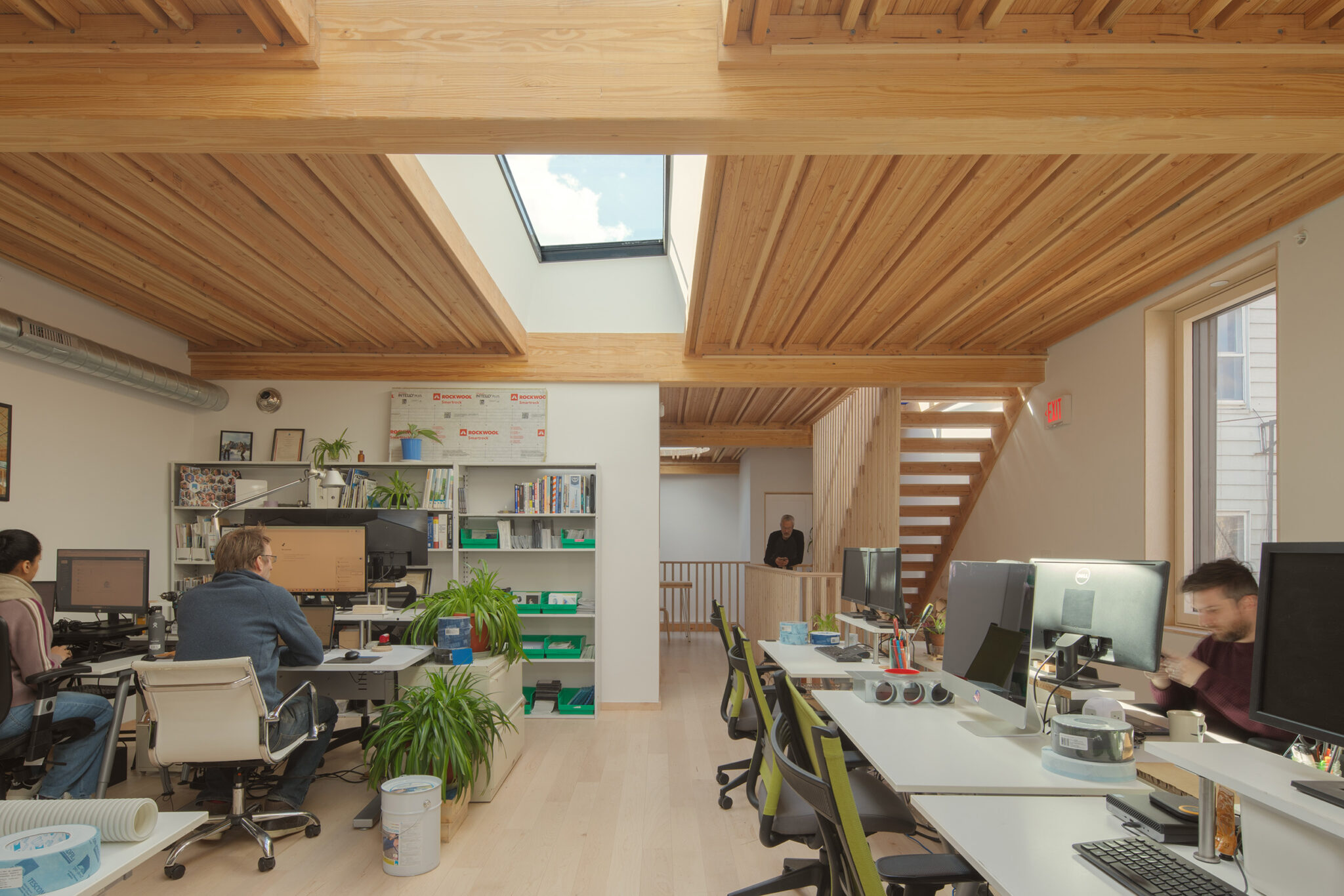
The array layout also had to be designed entirely around the building’s triple-pane skylights — a key part of the Passive House daylighting strategy. No shading, no structural loading near skylight zones, no compromising the envelope. The skylights came first. We worked around them.
Compliance: DOB, FDNY, and Electrical Code
This is the part of the work that doesn’t show up in the project photos — but it’s the part that determines whether the solar system ever actually gets turned on.
NYC commercial solar installations require coordination across multiple agencies. The Department of Buildings, FDNY, and electrical code all have specific requirements that have to be met, documented, and inspected. On a complex build like this one — with an architect of record, a structural engineer, and a separate canopy builder all working in the same DOB filing — our drawings have to tell a consistent story alongside everyone else’s. When they don’t, even in minor ways, it triggers reviews and objections that cost weeks.
We managed the full compliance and permitting process: filing, coordination with the project’s professional team, responding to agency review, scheduling inspections across an active construction schedule, and seeing the project through to final sign-off and close-out.
That kind of multi-agency, multi-party coordination is something we’ve built real experience doing. It’s not the most visible part of the work. But getting it right is what separates a project that closes cleanly from one that drags.
Canopy Height and Solar Code Requirements
One thing worth noting for anyone considering a canopy solar installation in New York City: there are specific clearance requirements that govern where and how a rooftop canopy structure can be built. In this case, the canopy needed to meet an 8-foot minimum clearance height beneath the array. Getting this right during the design phase — before permit filing — is what prevents costly revisions later. It affects where the structure can sit relative to parapets, how much of the roof can be used, and how the solar system integrates with the building code requirements that apply to rooftop structures.
The Result
The 8 kW photovoltaic system on the 475 Supply headquarters performs well — because the system was designed to perform, not just to fit.
On a building that was conceived from the ground up to minimize energy consumption, a poorly performing solar installation would have been a missed opportunity. We’re proud of the production numbers and, more broadly, proud that our scope was worthy of the building it’s part of.
Giving Credit Where It’s Due
We want to say this plainly: 475 High Performance Building Supply built something remarkable. The canopy is theirs. The design intent, the timber craftsmanship, the performance ambition — all theirs. They are a genuinely exceptional team, and working alongside them raised the bar for how we approached our own scope.
Kamtech Solar delivered the solar system — turnkey, compliant, and performing. Two different scopes. Both done with care. We’re glad our piece of the work was part of a project this good.
Frequently Asked Questions
What does “full turnkey solar solution” mean?
It means Kamtech Solar handles the complete solar scope from start to finish — engineering and system design, equipment procurement, full installation, all required permits and compliance filings, and final commissioning and close-out. You don’t need to coordinate multiple contractors or manage the permitting process yourself. One team, one scope, delivered complete.
Who built the canopy at 475 High Performance Building Supply?
The timber-framed rooftop canopy was designed and built by 475 High Performance Building Supply — not Kamtech Solar. Their expertise in mass timber construction and high-performance building is reflected in every detail of that structure. Kamtech Solar’s scope was the photovoltaic system: designed, permitted, installed, and commissioned by our team, integrated into the canopy 475 Supply built.
What compliance requirements apply to commercial canopy solar in NYC?
Commercial solar installations in New York City require coordination with the Department of Buildings, compliance with FDNY requirements, and adherence to electrical code. On a multi-party project, all drawings and documentation need to be consistent across the full professional team. Kamtech manages this process end to end — filing, agency coordination, inspections, and final close-out.
What is the minimum clearance height for a rooftop canopy solar installation in NYC?
Canopy structures used to support solar arrays in New York City are subject to specific clearance height requirements. On this project, the canopy was built to meet an 8-foot minimum clearance beneath the array. This affects where the structure can be positioned on the roof relative to parapets and other rooftop elements, and needs to be resolved during the design phase before permit filing.
How did the solar design account for the building’s skylights?
The array layout was designed from the start to work entirely around the building’s triple-pane skylights — no shading, no penetrations, no structural loading in skylight zones. The skylights are part of the building’s Passive House envelope and daylighting strategy. Our solar design works with that, not against it.
Does Kamtech Solar work on complex commercial and architect-led projects?
Yes. Projects involving multiple professional stakeholders, active construction sites, and demanding performance standards are where experience in compliance and coordination matters most. We’ve built the process for this kind of work, and we take it seriously.
Full project details and AIA New York recognition: 475 High Performance Building Supply — AIA New York
Project architect: Ryan Enschede Studio. Canopy design and construction: 475 High Performance Building Supply. Turnkey solar: Kamtech Solar. Full project team: bldgtyp, City Line Interiors, Hansen Becker Engineering, Jenny Flores Inc, John Deans, Murray Engineering, Spruce Mountain Inc.
Photos: Nicholas Venezia, Ryan Enschede.